
Records Behind a Lansing Resident Lookup
No public source is a complete Lansing roster. Each system confirms one role at one time. A voter tool checks a registration match, a docket identifies a party in a case, and a parcel record describes land and assessment facts. Vital records document events under strict access rules. Professional and business indexes connect a name to a regulated credential or filing. Read the result according to its stated purpose.
| Official source | Fact it can support | Custodian or system | How access works |
|---|---|---|---|
| Voter registration | A registration match and election information | Illinois and Cook County voter lookups | Public match tools; full voter file restricted |
| Court docket | Party role, case type, filing date, status, and events | Cook County Odyssey | Online summary; courthouse file is official |
| Property record | PIN, situs, parcel traits, assessment, and mailing distinctions | Cook County Assessor and tax portal | Free public search; not an occupant roll |
| Vital record | A birth, death, marriage, civil union, divorce, or adoption event | Cook County Clerk, IDPH, or circuit clerk | Eligibility, identification, form, and fees vary |
| License or entity filing | A regulated credential or named business role | IDFPR or Illinois Secretary of State | Public lookup; scope limited to each system |
Choose the first source from the clue already known. A full legal name and birth date fit the voter match. A case number belongs in Odyssey. A street address is better resolved to a PIN before a name is inferred. A profession can lead to IDFPR, while an entity name or file number belongs in the Secretary of State search. That choice keeps the resident lookup narrow and makes later cross-checks more reliable.
Look Up a Lansing Resident in Voter Tools
The Illinois registration lookup asks for first name, last name, birth date in MM-DD-YYYY form, and a five-digit ZIP. Submit runs the match and Reset clears it. Cook County uses a different public route: address plus last name can return the polling place, precinct or ballot, sample ballot, and mail-ballot status for an election cycle. Neither tool is a public list of every person at an address.
| Lookup | Required inputs | Possible output | Important limit |
|---|---|---|---|
| Illinois registration | First and last name, birth date, five-digit ZIP | Registration match | A mismatch can produce no result |
| Cook County voter information | Address and last name | Polling, precinct, ballot, and mail status | Output changes by election cycle |
A no-match result is not proof that a person is unregistered. Spelling, a changed address, the supplied ZIP, a protected address, or a service problem can all prevent a match. Record the exact query, access date, and election cycle, and do not expose a birth date or other nonpublic registration fields.
Confirm Lansing Names in Cook County Dockets
The Cook County online case information page warns that Odyssey supplies brief electronic summaries, may lag recent filings, and is not the official court record. Smart Search accepts a case number or a name entered as Last Name, First Name. Advanced controls include party, business, nickname, case type, status, filing dates, judicial officer, and location. A common surname may return many unrelated parties.
Result list. Up to 200 rows, with case number, defendant, file date, type, and status as the default columns.
Case detail. Identifiers, hearings, and events appear in reverse time order. The first 50 events load before Show More or Show All.
Official file. Courthouse files and repository copies remain controlling when a summary is incomplete or an image is needed.
District 6 at Markham is the practical local courthouse for Lansing. Its address is 16501 S. Kedzie Parkway, Markham, and the clerk phone is 708-232-4551. For an archived matter, form CCG0026 asks for the case or ticket, division, year, requester details, and payment; the listed archive search fee is $6. Federal cases instead use PACER.
Lansing Resident Lookup Through State Licenses
A professional clue can be checked with the Illinois Department of Financial and Professional Regulation lookup. It covers regulated people and entities, not every occupation or village permit. The successful capture below shows the official license-check starting point.
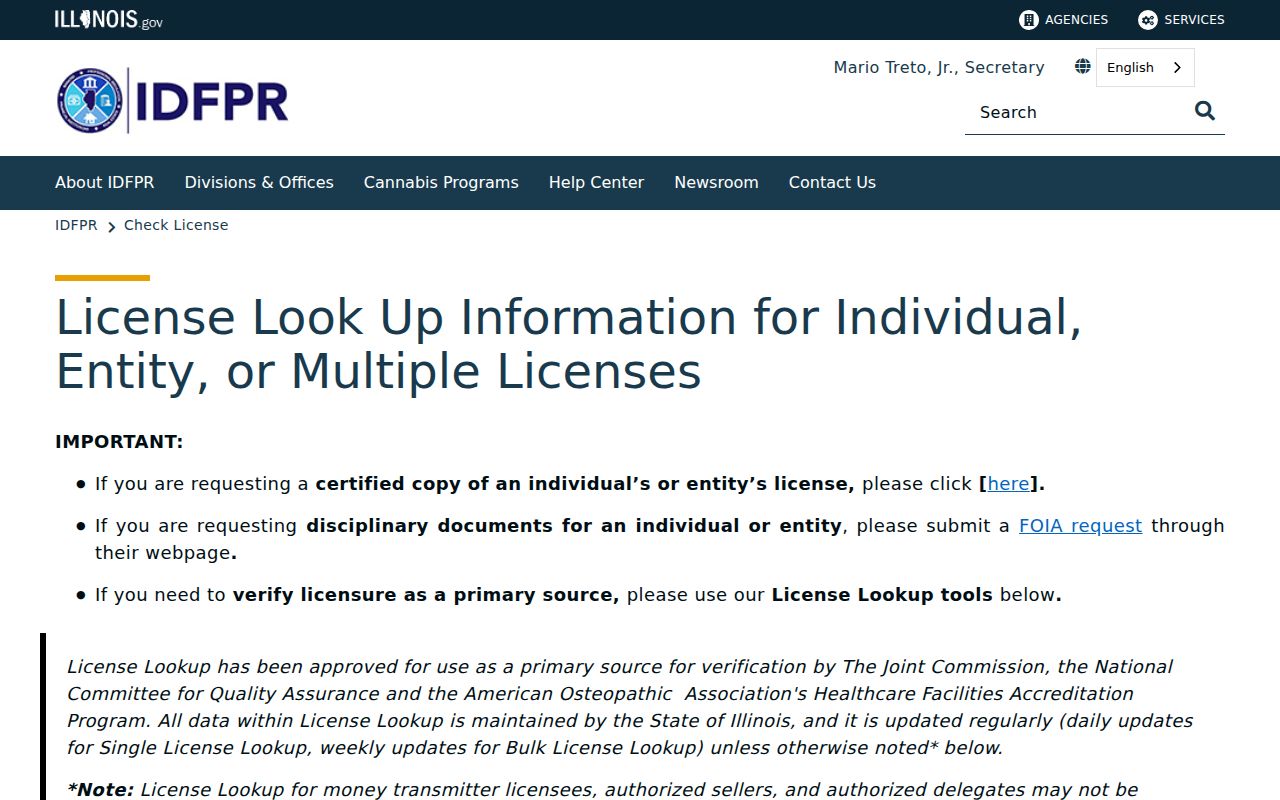
A license hit should be logged with the profession, credential status, name form, and access date. It supports a regulated role, but it does not prove a current Lansing home address.
The Illinois Secretary of State Business Entity Search is separate. It can search by business name, registered agent, president, secretary, manager, or file number. A detail may list the entity name, formation jurisdiction, status, registered agent and address, and officers or managers. Treat each label as a filing role rather than as occupancy evidence.
Illinois Criminal-History Boundaries for Lansing
The Illinois State Police criminal-history page explains the public route under the Uniform Conviction Information Act. The general public product is limited to conviction information. Name-based and fingerprint-based products differ, while CHIRP access is restricted. A missing result cannot establish that no arrest, sealed matter, juvenile case, non-conviction, or expunged record exists.
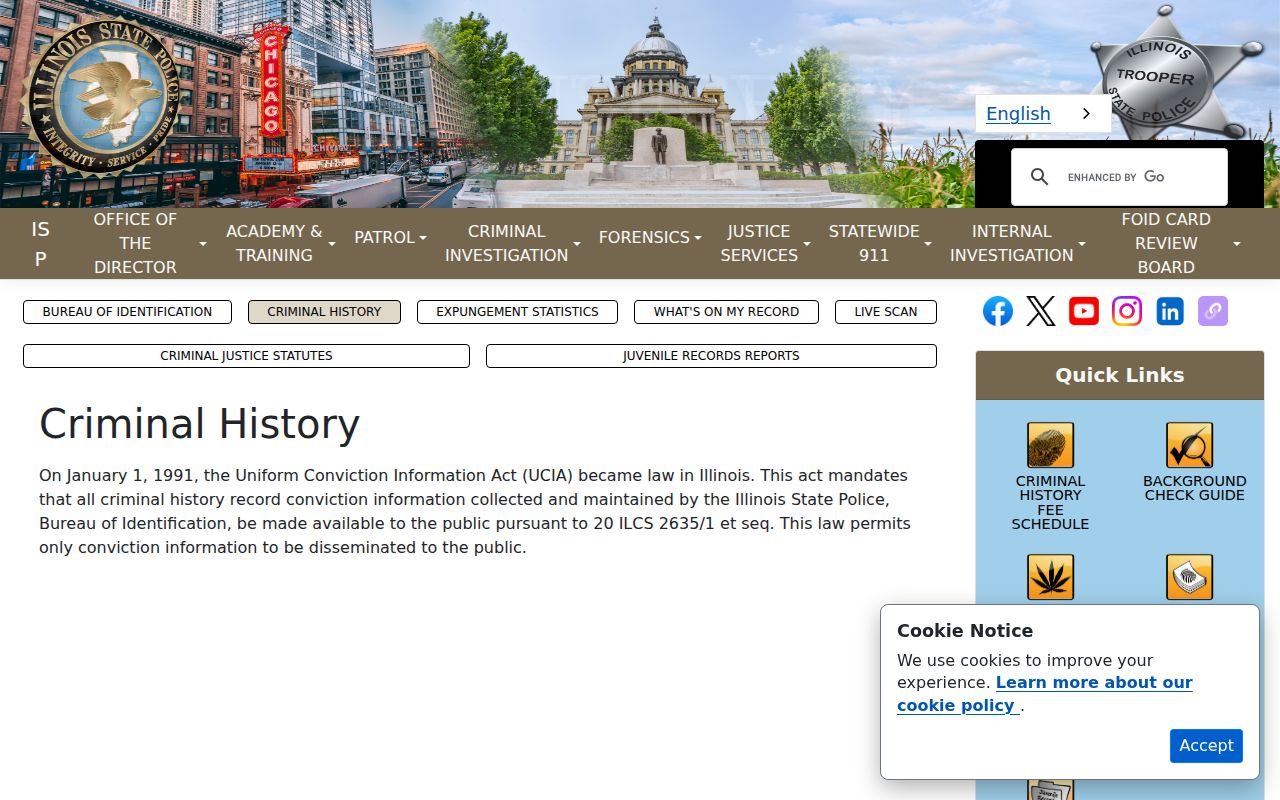
The image marks the state custodian route, not a general Lansing people list. Current custody is also split among the Cook County Individual in Custody Locator, IDOC, and the federal Bureau of Prisons. Registry and custody tools answer narrow statutory questions, so their results should never be blended into one undated profile.
Verify One Lansing Resident Across Records
A strong match uses two independent signals and preserves the role each source assigns. Name alone is weak. Add an address or PIN, date range, middle name, court location, event place, or regulated license. Do not force agreement when two systems use different dates or jurisdictions.
- Write the exact name, known date range, and the question the search should answer.
- Anchor the clue through the appropriate voter match, parcel PIN, license, or dated historical source.
- Search Odyssey or another relevant index with name variants, then record party role and jurisdiction.
- Use a vital-record request only when the event, eligibility, and needed copy type are known.
- Compare dates and roles. Mark uncertainty when only one source supports the identity.
- Docket
- A chronological court summary of filings, hearings, parties, and events, not the complete official file.
- Index versus image
- An index points to a record with selected fields; an image reproduces the underlying document and may require an order or fee.
- Certified copy
- A custodian-issued copy bearing official certification for a permitted requester and purpose.
Vital-Record Routes for Lansing Family Research
Lansing does not keep a public resident registry of births, deaths, marriages, divorces, or adoptions. Cook County Clerk handles county births, deaths, marriages, and civil unions, while the Illinois Department of Public Health supplies statewide certificate and verification guidance. Divorce copies come from the circuit clerk that granted the judgment. Adoption files are closed and follow state program or court routes.
Cook County genealogy copies are non-certified and marked for genealogical purposes. The county thresholds are births older than 75 years, deaths older than 20 years, and marriages older than 50 years. A request form asks for the event, name, exact or estimated date, place, and requester contact. Current records call for the proper relationship or direct and tangible interest, identification, a form, and payment.
For adoption-related family reunion research, Illinois IARMIE is a consent-based route for eligible adopted or surrendered adults, qualifying adoptive parents, certain birth relatives, and eligible minors through a representative. A confidential intermediary can apply in other qualifying circumstances. These programs protect identities until legal and consent rules are met; they are not open resident lookup databases.
A Lansing Record-Loss Lesson at Ridge and Burnham
The First Church Presbyterian cemetery story shows why a name search can end with a gap. The burial ground dates to 1860, a 1945 fire destroyed material, some consistory records survived, and later road and sidewalk changes altered the site context. A modern index cannot recreate every lost burial fact.
When this trail matters, combine the surviving church or cemetery record with a dated obituary, probate item, newspaper notice, or vital record. State exactly what was found and what was lost. One cemetery profile may support a date or family link, but it should not be stretched into a complete life history or proof of later residence.
Privacy Limits for a Lansing Resident Lookup
Illinois law opens some records and closes or redacts others. Full voter data is restricted to qualifying political use. Adoption records are closed. Court systems omit sealed, juvenile, expunged, and other protected material. Driver data, sensitive identifiers, and some police or vital details have separate limits. Illinois FOIA, 5 ILCS 140, is a route to existing public records, not a command to create a people profile or release exempt data.
The Illinois Address Confidentiality Program can provide a substitute address for eligible survivors. It cannot guarantee that every prior deed or property system will be hidden, so a public address should not be used to defeat a safety measure. If a record is wrong, save the URL, record date, access date, and disputed field, then seek correction from the custodian that maintains it.
Lawful use. Use a Lansing resident lookup only for lawful personal research. Never use an address, family link, or protected clue to stalk, harass, intimidate, or harm anyone.