
Lansing Address Sources by Era
No single roll lists every past household. The strongest backward trail joins a legal parcel record to sources created near the date being studied. Cook County deeds establish transfers, but an old telephone line or census entry is often better evidence of occupancy. The collection date matters as much as the name.
| Source | Years It Covers | Where Held | What It Shows |
|---|---|---|---|
| Recorded deeds and liens | Online working cutoff about 1985 forward; older records need confirmation | Cook County Clerk system and office | Grantor, grantee, dates, document number, PIN, and legal description |
| South Suburban telephone directory | 1959–60 confirmed | Library of Congress | Subscriber names, addresses, and telephone listings |
| Historic Lansing Journal | 1935 and 1937 examples confirmed | Lansing Historical Society | Civic notices, street references, businesses, obituaries, and names |
| Federal census schedules | Released historical years | Library databases and archives | Household members, ages, relationships, work, and enumeration geography |
| Parcel maps and imagery | Current layers; imagery to 1998 where available | CookViewer | Parcel shape, PIN, nearby lots, boundaries, and physical change |
| Local archival material | Varies by collection | Library and regional repositories | Directories, newspapers, cemetery, church, court, and county-history leads |
Treat an index as a pointer. A deed index proves that a document was recorded under named parties, not that either party slept at the site. Likewise, a telephone subscriber may represent one line used by several people. Pair two independent records before calling someone a former occupant.
Build a Lansing Deed Chain
Begin with the current address in the Cook County Assessor search and save the 14-digit Property Index Number, or PIN. A PIN identifies a tax parcel; it does not encode a street number. Check CookViewer next to confirm that the highlighted parcel matches the structure and lot intended. Then use that PIN in the Cook County Clerk Recordings System.
- Record the situs address, municipality, Thornton Township, PIN, parcel class, and the date checked.
- Search the recordings index by PIN, then examine deeds from newest to oldest. Save document, executed, and recorded dates.
- Follow each grantee back to the deed where that party was the grantor. Note trusts, corrections, plats, and associated document numbers.
- When a PIN changes, bridge the gap with the legal description, subdivision, lot, block, tract book, or recorded plat.
- Add an occupancy source for each period, such as a directory, census page, newspaper notice, obituary, or permit record.
A grantor is the party transferring an interest; a grantee receives it. These roles can belong to a person, trust, bank, or company. An executed date shows when parties signed, while the recorded date marks when the Clerk accepted the document. Keep both, since a late recording can make the order look wrong.
Best checkpoint. Write “owner identified, occupancy not established” until a source created for people, not parcels, supports residence.
Translate Old Lansing Addresses
An old Lansing address may not match a modern portal. Local history mentions Ridge Road, State Line, Burnham, School, Torrence, Oakley, and the Bernice or Bernardine spelling. Railroad geography and older community names also shaped how publishers grouped entries. Never replace the printed form without preserving it.
Create a translation line containing the original house number and spelling, publication date, place or township label, map or precinct, legal description or PIN if shown, modern candidate, evidence for the match, and the degree of doubt. Check nearby entries and the publication heading before deciding that a city label is wrong. A telephone book may cover several south suburbs under one exchange.
- Situs address
- The physical parcel location used by the assessor.
- Mailing address
- The place where a tax bill or notice goes, which may belong to an agent or former owner.
- Legal description
- The lot, block, subdivision, or land description that can survive a street-name or PIN change.
- Plat
- A recorded map showing lots, streets, easements, and subdivision boundaries.
No official Lansing conversion table for readdressing or annexation was confirmed. If two sources disagree, preserve both strings and explain the evidence. That is safer than forcing a neat modern answer onto an older record.
Pair Lansing Names With Dates
The 1959–60 South Suburban telephone directory offers a dated view of Lansing and nearby communities. Search by surname, then inspect the page heading and neighboring lines. A telephone listing is not a full household roster, but it can place a subscriber at a street address close to the publication year.
Move next to the Lansing city directory collections for the full shelf and methods. Compare spelling, initials, spouse notation when shown, street number, and exchange. Census records can add household relationships and ages, while newspapers can mark a move, sale, obituary, civic post, or business connection. Never merge people on surname alone.
| Field to log | Why it matters |
|---|---|
| Name exactly printed | Initials, maiden names, and variants prevent false joins. |
| Address exactly printed | Retains old spelling and number for later map work. |
| Source and date | Defines when the link was current. |
| Role | Separates occupant, owner, subscriber, relative, and applicant. |
| Corroborating record | Shows whether a second independent source agrees. |
Why Lansing Records Shift
Lansing grew through layers that do not fit one modern map. The official history describes German and Dutch settlement, the railroad arriving through the area in 1856, and an 1860 landscape of farms and small trades. Later clay work, brickyards, roads, and subdivisions changed parcels and street patterns. Early land may appear under township and legal-description terms before a modern address existed.
The Village of Lansing history gives the local chronology behind those shifts.
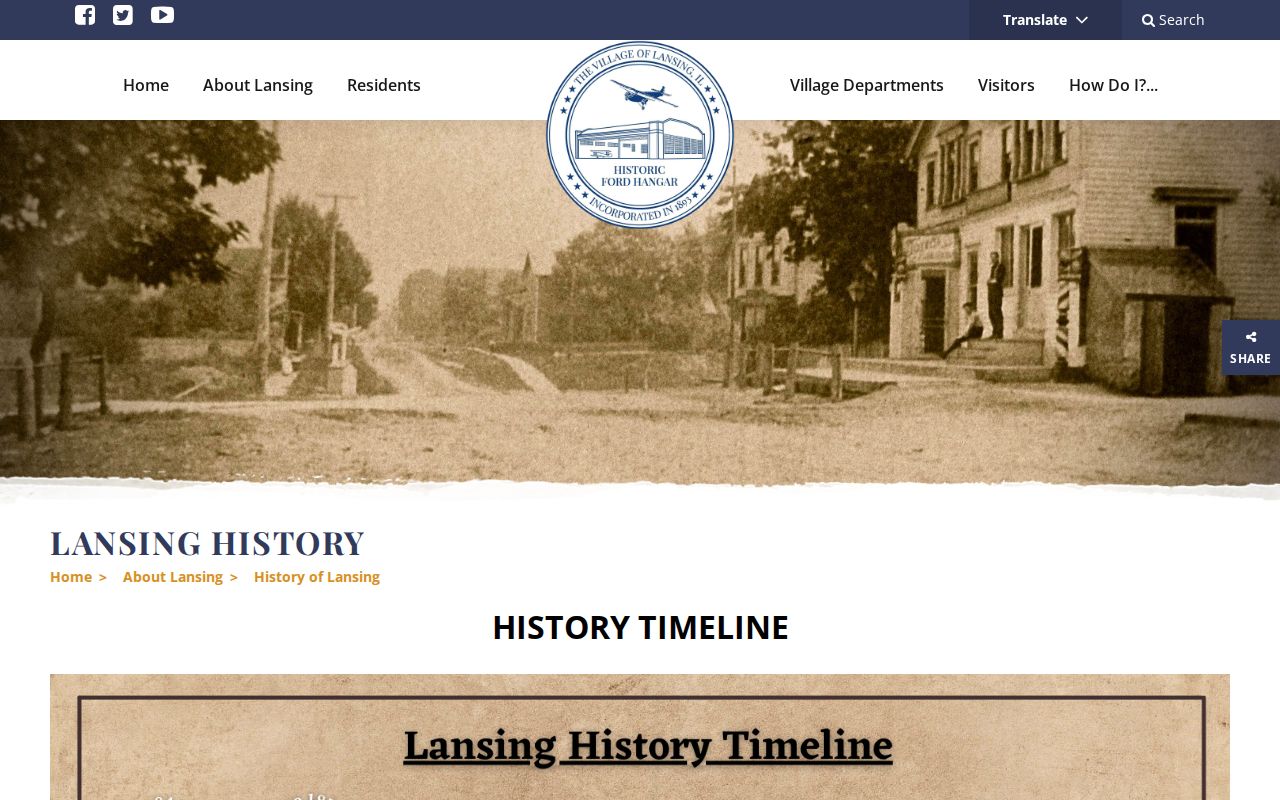
The captured village page is a bridge source: it helps place an old name or street in context, but deeds, maps, and dated directories still supply the evidence for a specific address.
Repositories also changed. Lansing Public Library began through a WPA-era effort in 1936, gained tax support in 1941, and moved into its 1976 building. Historic Lansing Journal scans preserve civic notices and address references. A 1945 church fire affected an older cemetery record trail. Those events explain why one period may be online while another requires a library, church, archive, or office inquiry.
Reach Beyond Online Lansing Records
When the online deed search stops, contact the Cook County Clerk Recordings Division about older indexes, tract books, plats, and copies. The in-person recordings office is in the Cook County Building at 118 N. Clark Street in Chicago. The Illinois Regional Archives Depository Cook County guide identifies county record series and repository contacts, while its recorder description explains historic deed and lien index fields.
Local routes matter too. Lansing Public Library databases include in-library genealogy and newspaper resources. The Lansing Historical Society documents page provides digitized Historic Lansing Journal issues. The South Suburban Genealogical & Historical Society holds cemetery, newspaper, directory, church, court, and county-history material. Ask with an address, name, date range, and the source already checked.
If municipal permit, inspection, zoning, or certificate records may settle the question, send the Village Clerk a narrow request under the Illinois Freedom of Information Act. State the exact address and date span, and separate each record type. No complete public historic address-keyed permit index was confirmed.
Note: An online cutoff marks a search limit, not the first year an older record exists.
Test Each Previous Resident
A useful conclusion shows its work. Keep the original address, normalized form, PIN, source title, date, page or document number, named party, role, access date, and any mismatch. If a directory gives one person and a deed gives another, both may be right: one may be the subscriber and the other the owner.
Can one deed identify everyone who lived there? No. It records a property transaction, not a household census. Add a dated people-oriented source and state what remains unknown.
Stop when the personal or family-history question is answered. Do not publish a protected address or add unrelated private facts. Historical research still deserves care, especially when a record could point to a living person.
Use records lawfully. Verify names with original sources, respect sealed or protected material, and never use an address trail to watch, threaten, or harass anyone.